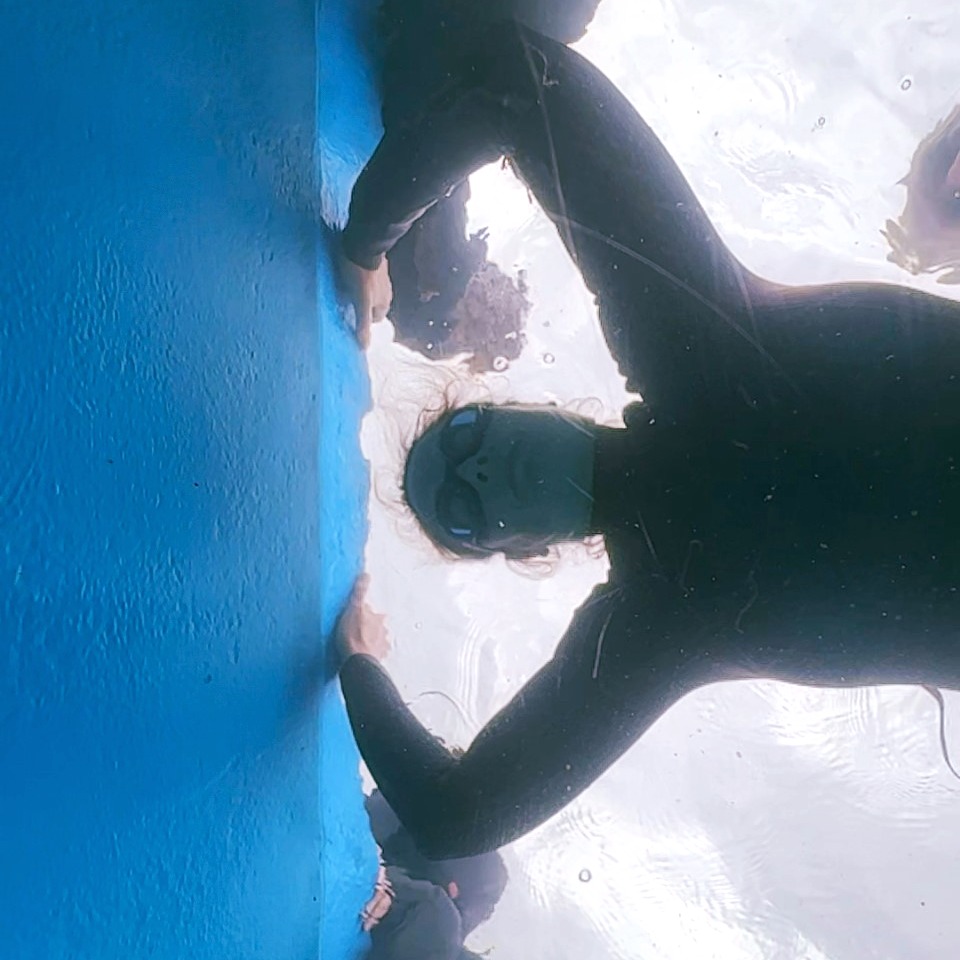
There’s a moment that happens underwater that tells you everything you need to know about yourself.
It’s not when you first hold your breath. Not even when discomfort begins.
It’s the moment your mind says: Breathe. Now!
That full bodied urgency that tells you that if you don’t, you will die.
And you realise… you don’t actually have to.
There’s a space between urge and reaction. That space is where our power lies.
I explored this deeply in my recent podcast conversation with performance stress specialist Jason Rice, founder of Apnea Survival. While his work was born in the surf, what he teaches extends far beyond waves.
It’s about how we function when pressure rises. And most importantly: how we stay calm inside it.
Because pressure is pressure. Whether it’s a hold-down underwater, a confrontation, financial stress, a relationship breaking down or standing at a life crossroads wondering if it’s too late to change.
Stress is physiological before it’s psychological
One of the biggest misconceptions I see in my work is people believing they’re bad at coping. That panic is a weakness and overwhelm is a personality flaw.
It isn’t.
While coping mechanisms are learnt very early in life, stress begins naturally in the body.
When pressure rises your physiology shifts instantly:
-
Heart rate accelerates
-
Breathing becomes shallow and rapid
-
Vision narrows
-
Hearing reduces
-
Cognitive thinking drops offline
You move from conscious response to automatic survival reaction.
For surfers, this shows up in challenging conditions or in a whipeout.
In life, it happens during arguments, deadlines, trauma triggers, or uncertainty. And it’s what women I work with experience in boardrooms, relationships, motherhood, grief, reinvention, and burnout.
Different environment. Same nervous system response.
Breath-hold training reveals your fear patterns
What fascinates me most about apnea training is how quickly it exposes emotional behaviour and psychological patterns.
Two people can have the same physical capacity, yet one stops far earlier.
One may stay calm in their breath hold, while the other will fidget and panic in the first seconds.
Why? Because often, the first thing that gives in is the mind. Not the body.
The urge to breathe mirrors the urge to escape discomfort in life:
The urge to quit the hard conversation
The urge to abandon your path
The urge to collapse under pressure
The urge to believe I can’t handle this
Training breath-hold teaches you to stay present inside intensity. And that skill transfers directly into emotional resilience.
This is why I integrate these principles inside my deeper coaching work. Because the real hold-downs most women face aren’t in the ocean. They’re psychological.
The good news is, the breath is your nervous system remote control
Your breathing is directly wired into your nervous system.
It’s automatic… yet voluntary.
That means you can consciously influence your stress response.
When you regulate your breathing:
Cortisol drops
Adrenaline stabilises
Cognitive thinking returns
Emotional reactivity reduces
You create thinking space.
And thinking space is what stops you from making fear-driven decisions you later regret.
This is one of the first pillars we work with inside the
Inner Power Mentorship: building internal safety before tackling external change.
Because no life transition is sustainable if your nervous system is dysregulated.
Regardless of what you are facing externally, knowing more about the way you function internally goes a long way.
In that sense, Surf Apnea brings a profound lesson: Discomfort does not equal danger.
And once you learn that, your threshold for stress expands everywhere else.
When it comes to reactions in stressful environments, we’re only ever as good as what we have trained.
That’s why Jason invites us to learn one method only and to drill it well.
In case of emergency, our mid-brain will be taking over conscious thinking to get us out of the situation faster. The kicker is, it will pick what it knows or make it up – and that last one can be devastating.
When under pressure, we fall back to our lowest level of training. Regardless of our intentions and knowledge.
Whether underwater or in crisis, the body deploys what it knows best.
This applies directly to daily life:
If you train calm, you access calm.
If you train panic, you access panic.
Which is why embodiment work matters more than intellectual understanding when it comes to facing challenging situations.
On the bright side, Calm is trainable
We often treat calmness as personality. But calm is physiological capacity and it can be trained.
Through breath, repetition, and controlled exposure to stress, you build:
Higher tolerance to pressure
Faster recovery from activation
Better decision-making under strain
Greater emotional regulation
It’s not about removing stress from life. It’s about becoming capable inside it.
The bridge between ocean and inner life
You don’t need to surf big waves to benefit from these teachings. Your waves might look like:
Leaving a career that no longer fits
Speaking truth in relationships
Reclaiming identity after motherhood
Facing grief
Starting again in your 40s or 50s
Trusting yourself after years of self-doubt
The intensity is emotional rather than physical. But the body responds identically, which means the training translates.
Calm is trainable.
Resilience is trainable.
Presence is trainable.
The deeper lesson Surf Apnea teaches
If there’s one truth breathwork reveals, it’s this:
You are safer than your mind thinks you are.
And when you learn to regulate fear signals instead of obey them, you unlock steadiness inside change. You no longer shriek when discomfort arises, and you make peace with stillness.
Not because life becomes easy, but because you become resourced enough to meet it.